
Inside the Core: Final Film of the Spring Semester
Tuesday, April 28, 2026
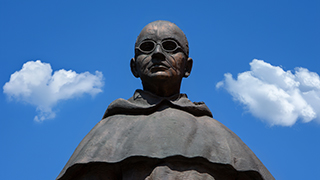
Statue of St. Maxmilian Kolbe
Inside the Core this week, at 1 p.m. on Thursday, April 30, we will host the last film in our spring film series, Triumph of the Heart, about St. Maxmilian Kolbe, a Polish priest who died at Auschwitz. The film depicts the final days of his life.
He was born in Poland in 1894 and became a Conventual Franciscan. According to his biography on the website of St. Maxmilian Kolbe Church in Toms River, NJ, as a child he had a vision of the Virgin Mary; he recalled, “That night, I asked the Mother of God what was to become of me, a Child of Faith. Then she came to me holding two crowns, one white, the other red. She asked me if I was willing to accept either of these crowns. The white one meant that I should persevere in purity, and the red that I should become a martyr. I said that I would accept them both.”
After becoming a Franciscan and ordained a priest, he completed a doctorate in philosophy at the Pontifical Gregorian University in 1915 and in 1919 a doctorate of theology from the University of Saint Bonaventure.
After serving in Japan, he returned to Poland for health reasons and was living there when the Nazis occupied it. The church biography notes that his monastery hid 4000 refugees, among them 1500 Jews. He also published a newspaper, The Knight of the Immaculate, which publicly criticized the Nazi. His paper printed these words, written by another, but, according to the church website, a key factor in leading to Father Kolbe’s arrest:
No one in the world can change Truth. What we can do and should do is to seek truth and to serve it when we have found it. The real conflict is the inner conflict. Beyond armies of occupation and the hecatombs of extermination camps, there are two irreconcilable enemies in the depth of every soul: good and evil, sin and love. And what use are the victories on the battlefield if we ourselves are defeated in our innermost personal selves?
Taken to Auschwitz, he was among a group of prisoners, one of whom had escaped. Nazi practice was to kill ten men for each escapee. One of the ten chosen was a family man, who pleaded not to be killed for that reason. Kolbe offered to go to the starvation bunker in place of the man. The film depicts his final sacrifice in that place.
One of the Core faculty members, Rebecca Marchinda, brought this film to the attention of the Core administration, and she has said it is an extremely powerful film. The Core is very grateful to her for bringing the film to light.
Please join us at 1 p.m. this Thursday in Mooney 336. Popcorn and candy will be provided.
Categories: Faith and Service