
Archbishop Caccia Visits Seton Hall for World Leaders Forum
Tuesday, December 2, 2025
Archbishop Gabriele Caccia, the Permanent Observer of the Holy See to the United Nations, visited Seton Hall for the World Leaders Forum on November 5. Archbishop Caccia joined the Holy See’s diplomatic service in 1991, taking on assignments across Asia and the Middle East before assuming his UN post in 2019. His work consistently emphasizes human dignity, understanding, and the common good, principles that formed the core of his discussion with students.
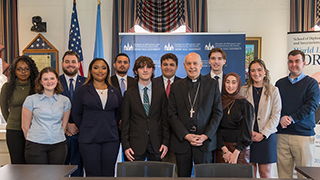
The visit began in the early afternoon with a small group discussion at McQuaid Hall including Diplomacy students, faculty and the archbishop.
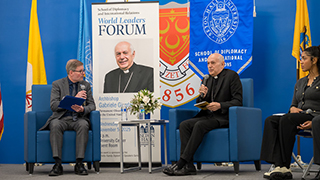
The main event continued at the University Center’s main lounge, with students, faculty and administrators in attendance. Participants from around the world were able to watch via livestream.
The program opened with remarks from Dean Courtney Smith of the School of Diplomacy and Seton Hall President Monsignor Joseph Reilly, who underscored the University’s commitment to fostering spaces for honest conversation about global affairs. Rather than presenting a formal lecture, Archbishop Caccia chose a conversational dialogue driven by questions asked by students themselves.
The archbishop began by outlining the foundations of Vatican diplomacy, noting that “Catholic means global, universal and diplomacy is something that deals with this.” His message was clear: the Church’s global mission naturally aligns with efforts to build bridges across cultures, faiths and political divides.
 When a student asked what he learned from his experiences engaging with religious
leaders at the UN, Archbishop Caccia pointed to Lebanon, a country that recognizes
many official religious communities, as an example of coexistence rooted in mutual
respect. “We know we are different,” he said, “but that does not imply that we have
to fight.” Understanding others, he noted, has deepened his understanding of himself,
and reinforced the Vatican’s belief that “we are all children of God.”
When a student asked what he learned from his experiences engaging with religious
leaders at the UN, Archbishop Caccia pointed to Lebanon, a country that recognizes
many official religious communities, as an example of coexistence rooted in mutual
respect. “We know we are different,” he said, “but that does not imply that we have
to fight.” Understanding others, he noted, has deepened his understanding of himself,
and reinforced the Vatican’s belief that “we are all children of God.”
Throughout the conversation, Archbishop Caccia returned to the idea that diplomacy is about relationships, not positions. “He’s not an enemy because he doesn’t think like me,” he said, referring to those we disagree with. Even in moments of conflict, the diplomatic approach requires us to think ahead, to what rebuilding will require and how societies can prevent future crises. “The use of force is not peace and not able to bring peace,” he reminded the audience.
On global humanitarian challenges, the archbishop was clear that ending war and other forms of violence must come first. “The priority of priorities,” he said, “is to protect the sacredness of the human person, of human life.” Charity, cooperation and a renewed commitment to human rights, he emphasized, are essential elements of sustaining peace.
Students from the School of Diplomacy who shared the stage with the archbishop brought forward questions ranging from Christian persecution to space governance. Graduate student, Reagin Jones, asked about treating space as a “common good.” She asked if society can ensure that the principles of peaceful use, transparency and the common good extend beyond governments and to the private sectors. Jones later described the exchange with Archbishop Caccia as profoundly meaningful. “He truly took the time needed to respond and then asked if I felt like anything was missing from his response,” she recalled. “He captured the essence of diplomacy perfectly and explained complicated concepts so well.” The archbishop emphasized the world’s need to preserve space and protect the existing guidelines.
By the end of the program, what stood out wasn’t a single policy point he made, but the way the archbishop approached each question with patience, a willingness to listen and a focus on human dignity and peace. His visit made clear that real diplomacy relies on patient engagement and an ability to work with people, even when views differ.
About the World Leaders Forum Engaging with Global Leaders
The World Leaders Forum provides an opportunity for speakers to encourage dialogue
in search of new avenues for building peace. As part of this signature program, the
School of Diplomacy has welcomed United Nations Secretaries-General António Guterres,
Ban Ki-Moon and Kofi Annan, UNGA President Ambassador Csaba Kőrösi; U.S. Ambassadors to the UN, Linda Thomas-Greenfield Samantha Power and Susan Rice;
Archbishop Christophe Pierre, Apostolic Nuncio to the United States; Nobel Peace Prize winners Nadia Murad and Leymah Gbowee; former Prime Minister of Great Britain and Northern Ireland Tony Blair; former Soviet President Mikhail Gorbachev; Iranian President Mohammad Khatami; and
former President of Poland Lech Walesa, among other distinguished visitors.
View a complete list of World Leaders Forum guests.
Categories: Nation and World