
Seton Hall Students Experience Italy on ‘Foundations of Christian Culture’ Study Abroad Trip
Thursday, March 19, 2026
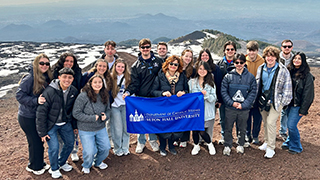
Students with Professor Murzaku at the summit of Mount Etna in Sicily.
Spring break may evoke images of beach vacations or trips back home, but for 20 Seton Hall students, the most recent pause in classes included an incredible academic and spiritual adventure a continent away. Students in the Catholic Studies Program’s course “Foundations of Christian Culture” ventured to Italy over spring break for a three-credit study abroad course led by their professor, Ines A. Murzaku, Ph.D., the founding chair and program director of the Department of Catholic Studies.
In Italy, not only did students discover deep connections between theological and historical concepts they had studied prior to embarking, but they also were surprised to learn life-changing lessons about the coexistence of contemporary Italian culture and the roots of Christianity. After experiencing life in 14 sites across Sicily, Reggio Calabria and Rome, the student group, which included all grade levels across multiple colleges and majors, is returning to South Orange with a newfound appreciation for the faith and history that continue to inspire the University.
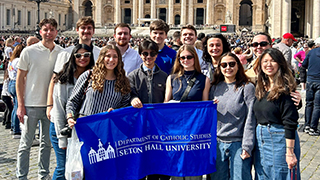
Students in St. Peter's Square for a Sunday Angelus with Pope Leo XIV
A Journey to Fourteen Cities
The study abroad course began in the vibrant heart of Sicily, where students explored
the intersection of diverse civilizations in Palermo and Monreale. There, the class
studied the gold-flecked mosaics of the Cathedral of Monreale — a UNESCO World Heritage
Site and visual masterclass in medieval theological art before continuing south to
the Valley of the Temples in Agrigento, offering a stark look at the Greco-Roman world
that predated and eventually integrated with early Christianity.
The spiritual heart of the Southern Italian leg included a visit to the Shrine of St. Francis of Paola, the patron saint of Calabria, as well as Paravati to visit the shrine built by Natuzza Evolo to honor the Immaculate Heart of Mary. Here, students reflected on the different faith traditions that have shaped Italian life for centuries and how each one is connected through Catholicism and an unwavering faith in God and the power of the human spirit.
“There were many highlights during this study abroad, and they require time to be fully reflected upon and absorbed,” said Murzaku. “For now, I find myself especially captivated by the Bronzi di Riace and by the Servant of God Natuzza Evolo, whose canonization is currently under investigation.
“At Seton Hall University, we have often been pioneers; perhaps we might be so here as well, contributing in some way to the Vatican’s investigation into Natuzza’s canonization, particularly since our students are already eager to study her simple, humble, and seemingly ordinary life, which proved to be anything but ordinary,” the professor continued. “Such is often God’s way: to work through the humble, the hidden and the least expected.”
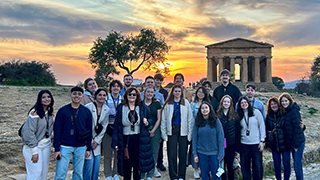
Students with Professor Murzaku at the Valley of the Gods, a UNESCO World Heritage Site, in Agrigento.
From Volcanic Peaks to Ancient Bronzes
The itinerary was as physically diverse as it was academically rigorous. In Sicily,
the group touched the sands of beaches in Catania and climbed the slopes of Mount
Etna, Europe's highest active volcano, before crossing the Strait of Messina into
Calabria and eventually venturing northward to the cobblestoned streets of Ancient
Rome. In Reggio Calabria, the students stood face-to-face with the Riace Bronzes,
miraculously preserved ancient Greek statues that represent the pinnacle of classical
humanism.
The Road to Rome
The final stretch of the program brought the group to the "Eternal City." In Rome,
the curriculum shifted toward the institutional and architectural triumph of the Church.
Students conducted site visits to the Colosseum, the Roman Forum and Baroque landmarks
such as the Trevi Fountain and Pantheon, mapping out the transition from a pagan empire
to the center of Western Christendom.
“I never thought I would be able to have so much fun with people I had just gotten to know that week. One moment that sticks out in my memory is going out to see the Colosseum and Trevi Fountain with all my classmates,” said Nicholas Schneider ’26, majoring in Finance with a minor in Business Law. “Having been to Rome in the past, I knew how breathtaking the sights were and felt very fortunate to be able to see all their reactions to witnessing them for the first time. All of the trip, but specifically this moment, will forever be a fond memory of my years at Seton Hall”.
The study abroad trip reached a spiritual peak at St. Peter’s Square, where students gathered with thousands of pilgrims from around the globe to attend the Sunday Angelus with Pope Leo XIV. For those in attendance, seeing the global nature of the Church in person was the ultimate capstone to their studies.
As the Pirates returned to South Orange, they brought back more than just souvenirs; they returned with a deeper understanding of how the foundations laid in the Mediterranean thousands of years ago continue to support the world they live in today and the faith that guides Seton Hall.
Categories: Education, Faith and Service, Nation and World